
The Suspicions of Mr. Whicher by Kate Summerscale
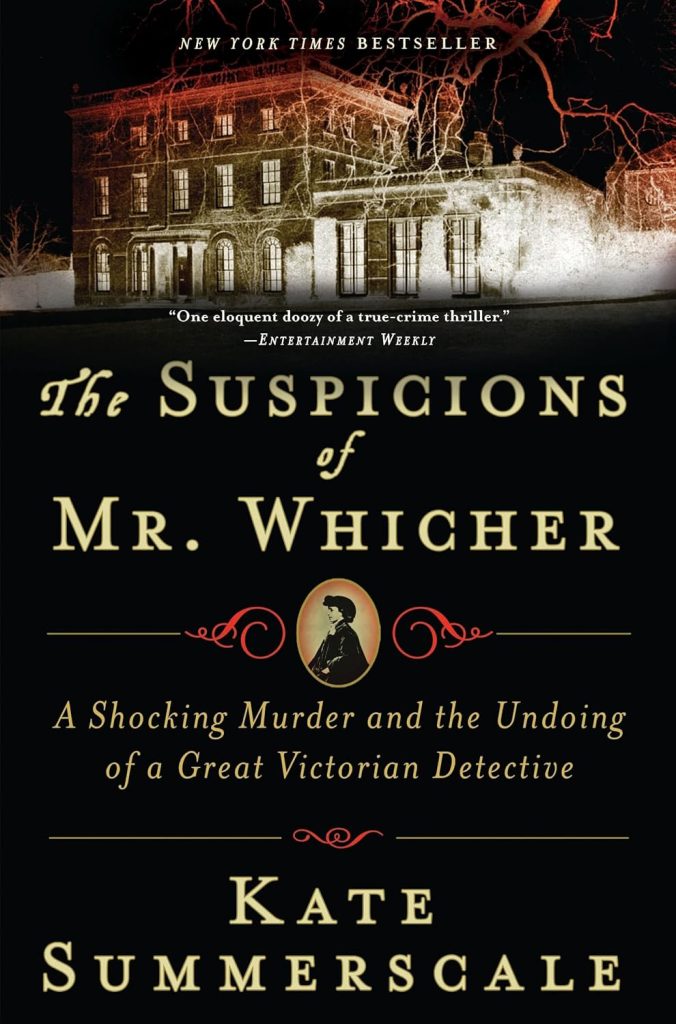
First line: On Sunday, 15 July 1860, Detective-Inspector Jonathan Whicher of Scotland Yard paid two shillings for a hansom cab to take him from Millbank, just west of Westminster, to Paddington station, the London terminus of the Great Western Railway.
Summary: It was in June of 1860 that the body of a small boy, Saville Kent, was found at the bottom of an outdoor privy (outhouse). He had his throat cut and dumped in the hole sometime during the night. The crime shocked the local community but it became national news upon the arrival of Detective Jonathan Whicher.
Detectives were a new invention and only a few existed in England. Upon his arrival at the Kent home, he began to suspect that someone inside the house was the perpetrator. Nevertheless, without clear evidence or a confession he was unable to prove anything. With the crime unsolved, he returned to London with his reputation in tatters. It was years later before justice was finally served and his theories proved correct.
My Thoughts: Last year I read Summerscale’s newest true crime book, The Peepshow, and found her work very intriguing. She goes to great lengths to research the people, the period and the workings of the criminal justice system.
Again, in this one she does the same. She lays out the events of the night in question, gives us information about the family and servants and explains how murders were investigate and solved in Victorian England. The most interesting part to me was the family dynamic. From the outset, you can tell that there is some strife going on in the household and it has made for a toxic environment. I think from early on you know who the killer is but with the lack of evidence and new art of detecting it is hard for Whicher to prove.
It is hard to imagine a world without a police force patrolling and investigating crimes but before 1829, there was no organized police to handle crime. So even by 1860 everything was still rather new. Quite a bit of the middle is spent on how the job of a detective was new and making its way into popular fiction as well. Summerscale gives examples of some of the first fictional detectives from books by Charles Dickens and Wilkie Collins. While this is true crime, it also seems to be a history of detecting too.
This was a fascinating look into the world of a Victorian middle class family. By the end, we learn the fate of each of the main players in the story. I enjoyed this for the true crime but also the social history it presents.
FYI: Murder of a child.